Quantum devices: breaking boundaries
Francken's annual Symposium
Welcome to the 2026 Francken Symposium
Welcome to the website of the annual Francken Symposium! This year's theme is Quantum devices with the slogan "Breaking boundaries".
About the Symposium
Quantum devices origin traces back to the early 20th century, when physicists like Max Planck and Albert Einstein revolutionized science by discovering that energy exists in discrete packets called "quanta." This theoretical groundwork led to the "first quantum revolution" in the mid-1900s, producing foundational technologies like the transistor and the laser which drive the modern internet and electronics. Today, we are navigating a "second quantum revolution" focused on manipulating individual particles. Beyond computing, quantum utility is already established in daily life: atomic clocks use quantum oscillations to enable the GPS on your phone, and MRI machines rely on the quantum spin of atoms for medical imaging. Emerging applications also include unhackable quantum cryptography for banking security, and ultra-sensitive quantum sensors used in geology and brain diagnostics.
Our Speakers
Day Chair
Roberto Lo Conte
University of Groningen
Roberto Lo Conte obtained his Bachelor's and Master's degrees in Physics from the University of Naples Federico II. He completed his PhD at the University of Mainz, Germany, focusing on nanomagnetism and spintronics...
Roberto Lo Conte obtained his Bachelor's and Master's degrees in Physics from the University of Naples Federico II. He completed his PhD at the University of Mainz, Germany, focusing on nanomagnetism and spintronics. Following postdoctoral research at UC Berkeley and the Paul Scherrer Institute in Switzerland, he joined the University of Groningen. He is currently an Assistant Professor at the Zernike Institute for Advanced Materials (ZIAM), where his research group explores novel magnetic spin textures and their dynamics in quantum materials, aiming to lay the groundwork for next-generation, energy-efficient computing and memory devices.
Romana Schirhagl
RUG / UMCG
Romana Schirhagl is a Professor at the University of Groningen and University Medical Center Groningen (UMCG), where she leads a research group focused on quantum sensing for biomedical applications...
Romana Schirhagl is a Professor at the University of Groningen and University Medical Center Groningen (UMCG), where she leads a research group focused on quantum sensing for biomedical applications. She obtained her PhD from Vienna University and later co-founded the spin-off company QTsense to commercialize quantum sensing equipment. At the symposium, she will speak about magnetometry for biological systems.
Ishitro Bhaduri
Guest Speaker
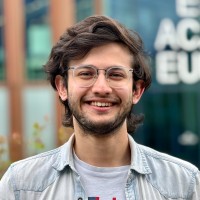
Ishitro Bhaduri is a PhD student at the CogniGron Institute in the University of Groningen...
Ishitro Bhaduri is a PhD student at the CogniGron Institute in the University of Groningen. He is part of the Spintronics of Functional Materials research group, focusing on developing unconventional computing paradigms based on complex oxides. In the symposium, he will present a talk titled "From spintronics to neuromorphic computing".
Loredana Protesescu
RUG
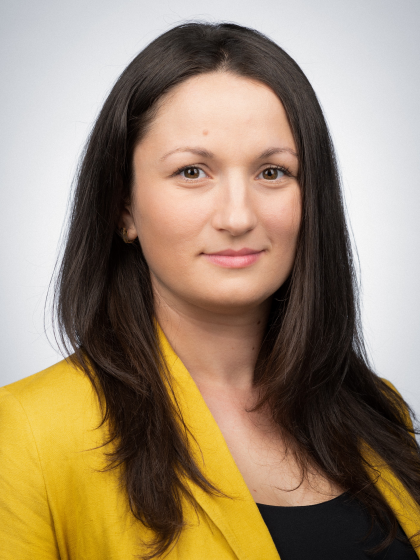
Loredana Protesescu is an Associate Professor at the University of Groningen, Zernike Institute for Advanced Materials, where her research focuses on quantum dots and advanced functional nanomaterials...
Loredana Protesescu is an Associate Professor at the University of Groningen, Zernike Institute for Advanced Materials. She obtained her doctoral degree at ETH Zurich and later continued as a postdoctoral scholar, then a postdoctoral fellow at the Massachusetts Institute of Technology. At the symposium, she will present her work on advanced functional nanomaterials, with a focus on quantum dots.
Douwe van Netten
RUG
Douwe van Netten is a PhD student working in the Antonija Grubisic-Cabo Group at the University of Groningen. His talk will discuss how chemical modification can tune the properties of layered materials, focusing on Bi-substituted PtTe₂ and how this affects its surface chemistry and stability...
Douwe van Netten is a PhD student working in the Antonija Grubisic-Cabo group at the University of Groningen. His talk will focus on how chemical modification can tailor material properties for device applications, using Bi-substituted PtTe₂ as an example. PtTe₂ is a type-II Dirac semimetal with promising catalytic and transport properties, but changing its electronic structure can also affect its surface chemistry. Using X-ray photoelectron spectroscopy, the work shows that Bi substitution makes PtTe₂ more susceptible to oxidation and introduces new surface reaction pathways. This highlights why surface chemistry must be considered when designing functional layered materials for future devices.
Angeliki Nikolaou
RUG
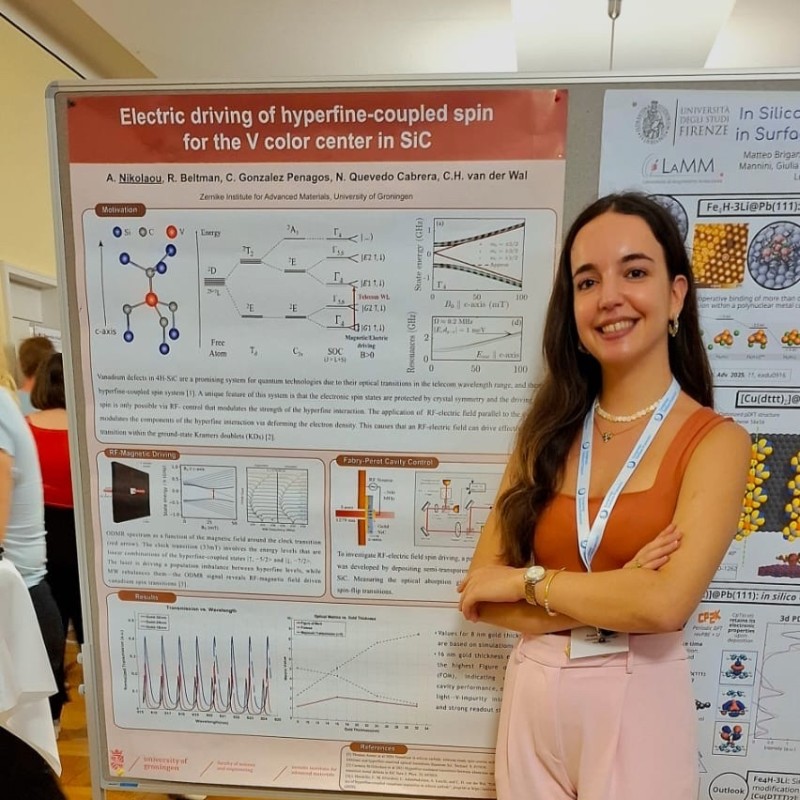
Angeliki Nikolaou is a PhD student working in the Van der Wal Group at the University of Groningen. Her talk will focus on vanadium defects in silicon carbide, which can act as optically active color centers for quantum communication applications...
Angeliki Nikolaou is a PhD student working in the Van der Wal Group at the University of Groningen. Her talk will focus on vanadium defects in 4H-silicon carbide, a material that can host optically active color centers. These defects can absorb and emit light in the near-infrared telecom range, making them interesting for quantum communication through existing fiber-optic networks. The talk will explain how the quantum states of vanadium defects can be controlled and read out, especially the spin states of the bound electron that carry quantum information. It will also discuss how RF electric fields can be used instead of magnetic fields to drive electron spin transitions.
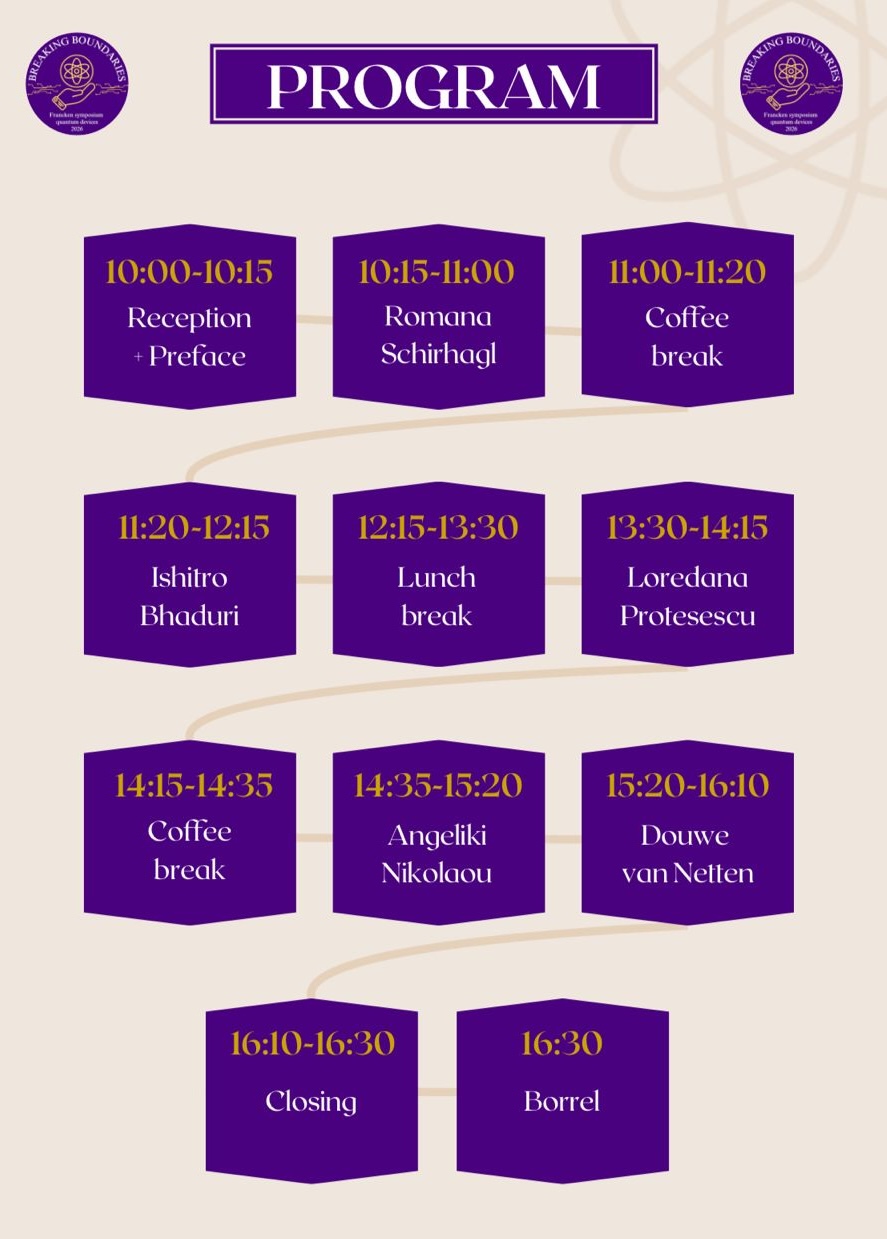
Day Plan of the Symposium
Pictures from the 2025 Symposium
Sign Up to the symposium!
Scan the QR code or click the button below to register for the symposium.
Sponsors
The Zernike Institute for Advanced Materials (ZIAM) is a leading national and international research center at the University of Groningen. Our institute is dedicated to unravelling the properties of novel materials and translating these fundamental discoveries into applications that address pressing societal challenges. We utilize a multidisciplinary approach, bridging physics, chemistry, and biology to design, synthesize, and investigate new materials.
At ZIAM, our mission focuses on discovering materials with unprecedented properties. From developing the foundational concepts for quantum devices, spintronics, and topological insulators to creating sustainable energy solutions and bio-inspired materials, our researchers operate at the cutting edge of nanoscience. We are deeply committed to connecting fundamental research with technological advancement.
Our institute provides a highly collaborative and international environment, bringing together top-tier scientists and students from around the world. By integrating theoretical modeling with advanced experimental techniques, ZIAM continues to push the boundaries of materials science, training the next generation of researchers and ensuring a lasting impact on both academia and industry.
KIVI, the Royal Institute of Engineers, is the professional association for engineers (ir./ing.) in the Netherlands. We represent highly skilled technical professionals and provide a platform to connect, share knowledge, gain inspiration, and develop professionally.
Engineers are at the heart of technological progress and play a key role in addressing societal challenges. KIVI supports their professional practice, promotes the quality of education and research, and helps make the impact of technology on society visible.
We collaborate with industry, knowledge institutions, education, government, and international partners to strengthen the role of engineers in society.
ASML is a leading innovator in the global semiconductor industry. Working closely with our customers and partners, we provide lithography systems – hardware, software and services – that help chipmakers create more powerful, affordable and energy-efficient microchips. These chips power modern life and help address some of humanity's toughest challenges.
In the past four decades, we have grown from a small startup into a multinational company with a team of over 44,000 people and total net sales of €32.7 billion in 2025.
In 2025 alone, we invested €4.7 billion in R&D, empowering our teams to drive innovation and to keep pushing the boundaries of technology. Our researchers, engineers, manufacturing specialists and high-tech hardware and software experts work in close-knit, multidisciplinary teams. They share knowledge and ideas as they listen to and learn from one another, working at the edge of what's technologically possible.
If you are passionate about technological advancement, please visit ASML Careers .
Meet the Committee
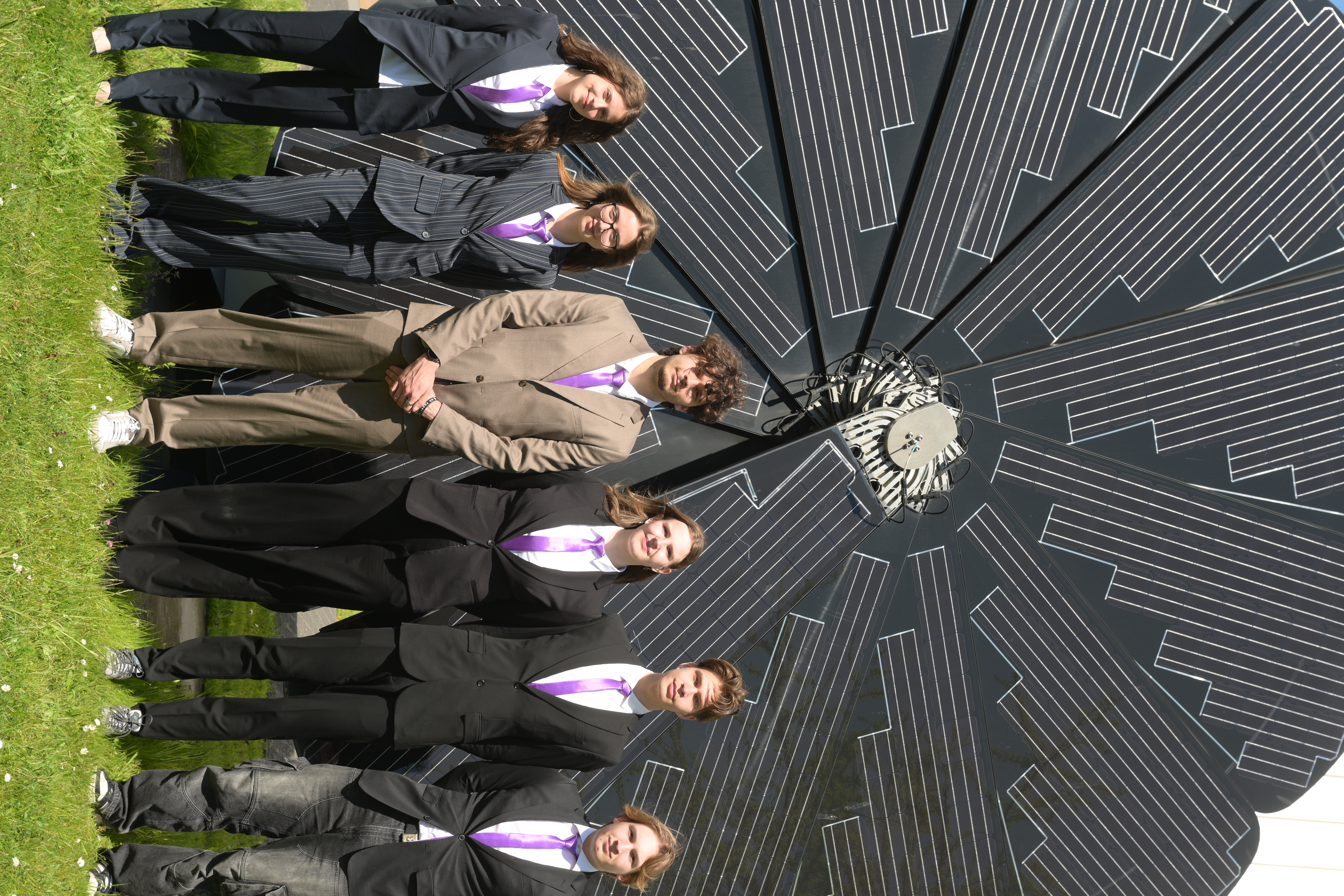
The symposium is organised by a dedicated committee of students who worked together to arrange the speakers, sponsors, location, promotion, and overall programme. From left to right:
- Imogen Legge
- Lara Nicol
- Riccardo Carlini
- Noa Krosse
- Jan Jager
- Dominik De Wit